
What Dearborn County Deed Records Reveal
The county Recorder's Doxpop index ties names to recorded conveyances in Dearborn County. A deed records the transfer itself along with its legal description. Mortgages and liens are different animals. They record encumbrances, not ownership.
| Deed Type | What It Does | Common Use |
|---|---|---|
| Warranty deed | Conveys with stated covenants | Ordinary sale |
| Quitclaim deed | Conveys whatever interest exists | Corrective or family transfer |
| Trustee or executor deed | Conveys under trust or estate authority | Trust or probate |
| Sheriff's deed | Records a court-ordered sale transfer | Completed foreclosure sale |
| Tax deed | Records a completed tax-sale conveyance | Tax sale |
Each instrument in the Dearborn County index does its own job. A deed conveys title. A mortgage secures a loan. A lien asserts a claim against the land. A release can discharge an earlier filing. Sitting in the same index does not make them equivalent.
Search Dearborn County Deed Records with Doxpop Controls
| Control | Availability | Purpose |
|---|---|---|
| Party Name | Required, basic | Find an indexed grantor, grantee, or party |
| Super Search | Optional | Broaden the name search |
| Search Region | Basic selector | Limit the query to Dearborn County |
| Legal Description | Advanced | Find rural and subdivision wording |
| Document Information | Advanced | Refine by instrument data |
The Dearborn recorder index does not require an address or APN to run a search. Rural deeds often appear without any street address at all. In that case, try party name variants and search the section, township, range, subdivision, lot, or survey wording tied to the parcel.
Separate Dearborn County Deed Records Coverage Dates
Coverage in Dearborn County depends on what you are looking for. It also depends on when it was filed. Doxpop indexes all document types from July 2000. A historical expansion completed on June 12, 2025 pushed deed indexing back to 1988. It also made scanned historical deeds and paper-index material browsable to 1903. That deeper date has limits. Not every mortgage, lien, plat, release, or survey is fully indexed to 1903. Name the instrument and the access mode whenever a cutoff matters.
The expansion is a real gain for former-owner research in Dearborn County. Still, earlier deed records live in Recorder books, microfilm, and archival sources. They are not in the online index.
Walk Dearborn County Deed Records through the Grantor-Grantee Index
Doxpop's basic Dearborn search starts with a party name. It also offers Super Search and Search Region controls. Advanced access adds Legal Description and Document Information fields. Remember the date tiers: all document types begin in July 2000, deeds reach back to 1988, and historical deed material is browsable to 1903.
- Find the current owner's acquisition deed with that owner as grantee.
- Compare its legal description and parcel references.
- Search the named grantor as a grantee to locate the preceding transfer.
- Repeat, then use deed books, microfilm, and Recorder help before the online cutoff.
- Grantor
- The conveying party.
- Grantee
- The receiving party.
- Chain of title
- The ordered sequence of conveyances for one legal description.
- Book/Page vs Instrument #
- Alternative references used to retrieve a recorded document.
Read Replats and Probate Transfers in Dearborn County Deed Records
A tidy chain can split without warning in Dearborn County. Replats, new condominium regimes, and estate conveyances through a personal representative all branch the record. Use the GIS Subdivision field as a local starting point. Then search the named plat or phase in the Recorder records. Match the current PIN to the deed or survey reference and the legal description. Do not trust the street address alone.
Probate can explain who had authority to sign. But the recorded deed is still the land-record event. A court filing that mentions real estate is not automatically a completed transfer.
Property Watch Signals New Dearborn County Deed Records
Doxpop Property Watch watches one name at a time in Dearborn County. An alert flags an indexed name match. It cannot block a document. It cannot promise the filing touches your parcel. Doxpop's own guidance notes that rural section, township, and range descriptions can trigger false positives. Address and APN are not used for matching. Open the document and read the legal description before reacting.
The 1826 Fire Changes Early Dearborn County Deed Records Research
Dearborn County's 1826 courthouse fire destroyed much of the early record group. Some marriages and wills survived. When a chain dies out near the fire, work the surrounding evidence: later deed recitals, surviving probate, Recorder books, State Library microfilm, plats, atlases, newspapers, directories, and cemetery records. The Indiana State Library research guide maps the surviving and microfilmed material.
Context can explain a gap in Dearborn County deed records. It cannot replace an instrument that burned.
See the Dearborn County Deed Records Search Entry Point
The Doxpop recorder portal is the county-directed online route for the public instrument index.
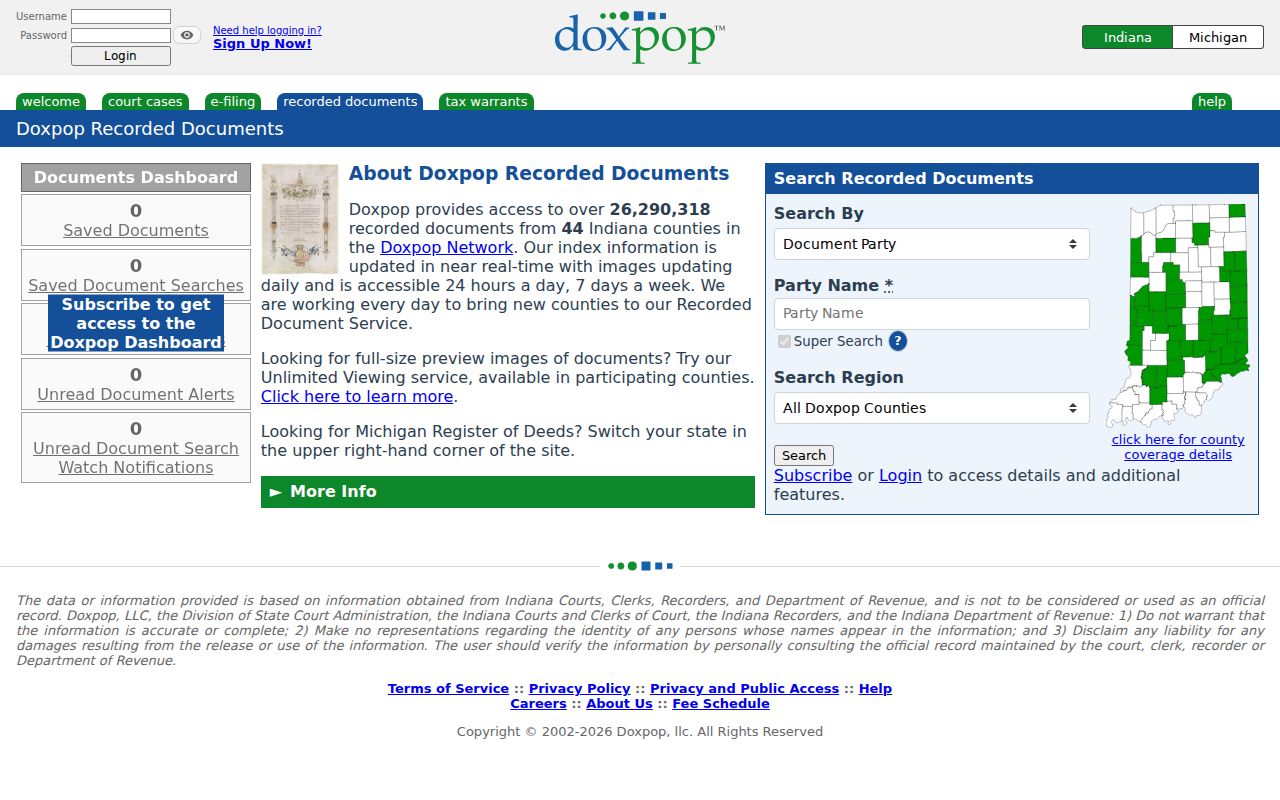
The official Dearborn County search page is built around parties rather than parcels. Start with an exact grantor or grantee name and a Dearborn region selection. Refine by legal description once the party results come back.
Read the Dearborn County Deed Records Instrument Inventory
Doxpop's Dearborn document types reach well past deeds. The list spans affidavits, annexations, assignments, cemetery deeds, and condominiums. It also includes delinquent sewer liens, federal tax liens, final decrees, mechanics liens, mortgages, plats, powers of attorney, real estate contracts, releases, subdivision plats, and surveys. A name in the index might belong to a borrower. It could instead be a lien claimant or a representative rather than a buyer or seller. Read the document type and the party's role before adding any instrument to a chain.
Cross-references tie instruments together. A mortgage links to its release, or a corrective filing to the document it amends. Detailed access may show parties and addresses where available, scanned non-confidential images, and related instruments. Confidential or restricted material follows a different access path from ordinary deeds. Military discharges carry special statutory treatment. Treat them as their own category, even though the Recorder maintains them alongside land records.
Use Every Dearborn Copy and Inspection Channel
An online image is convenient for everyday work. A certified Recorder copy is the right form when certification matters. The Recorder publishes no stable current fee schedule, so call before paying. Give staff a party name, a recording date or range, the document type, and a book/page or instrument number whenever possible. Specific retrieval information keeps a copy request from sounding like a request for the county to create a title analysis.
If Doxpop does not carry the needed image, inspect the record at the Recorder counter. You can also submit the county APRA form for an existing record. The form supports inspection or copying and delivery by fax, email, or mail. County materials state a response within 24 business hours for hand-delivered requests. Seven calendar days apply to fax, mail, or email requests. A response may simply acknowledge the request or explain access. A complex historical retrieval is not necessarily finished within that window.
Audit Each Link in the Dearborn Deed Chain
Give every conveyance its own row on a chain worksheet. Record the date, grantor, grantee, deed type, and book-and-page or instrument number. Add the legal description and the source image you consulted. Start from the current parcel and its newest deed. Then walk backward through each grantor named in that instrument. This approach surfaces a broken link quickly. A narrative family history tends to bury the same gap.
Compare legal descriptions line by line. Rural Dearborn County land is described by section, township, and range. Platted property uses subdivision, lot, block, replat, or phase. A condominium depends on its declaration and unit references. Acreage, PIN, and street address can help, but the Recorder index does not guarantee them. When wording shifts, hunt for a plat, survey, corrective deed, annexation, combination, or split. Only then consider whether the chain jumped to different land.
Estate and court events need their own discipline. A probate appointment establishes authority; the later deed records the transfer. A foreclosure complaint conveys nothing by itself. Check the case outcome, then look for a recorded sheriff's deed or a later release. A tax sale is not a completed tax deed. Keep event, authority, and recorded transfer in order.
Older research grows less linear before the online era. Use the scanned deed material from 1903 forward where it exists. Then ask the Recorder about earlier books and indexes. The State Library guide, plat books, maps, city directories, Sanborn holdings, newspapers, and surviving probate files can identify parties and geography. Around the 1826 loss, later deed recitals matter most. They may describe an earlier interest whose original instrument no longer survives.
Order a Dearborn County Deed Copy
Index basics are free. Images and details may cost a fee or an account. For a certified copy, call the Recorder at (812) 537-8837 and ask for the current fee schedule. Material that is not online can be requested through the county APRA form, listing parties, date range, document type, and reference. Remember that the 1826 courthouse fire destroyed much of the earliest record set, so surviving wills, later deed recitals, State Library microfilm, and maps may carry the load.
Give the Recorder enough detail to pull one existing instrument. Include indexed party names, an approximate recording date, document type, and the instrument number or book and page. If an online image is gated or missing, ask whether counter inspection, email, mail, or an APRA request fits best. Keep the certified copy and its retrieval reference together. For a rural tract, supply the section, township, range, and full legal description. For a platted lot or condominium, give the subdivision, phase, lot, block, or unit wording. These details cut false matches and tie the deed to the right Dearborn County parcel.
Recorded, not guaranteed. The index shows what reached the Dearborn County Recorder. It is not a title opinion, and unrecorded interests may exist.