
Trace Back Dearborn County Former Owners
Work from the newest deed backward. Each grantor on that deed becomes the next grantee you hunt for in an earlier volume. Names and dates alone will not carry the chain. Beside every transfer, note the legal description, the subdivision or section, and the book, page, or instrument reference so the parcel stays fixed while the parties change.
| Transfer date | Grantor to grantee | Deed type | Book/page or instrument |
|---|---|---|---|
| Newest recorded date | Prior owner to current grantee | Use the indexed type | Copy the exact reference |
| Earlier acquisition | Next prior owner to that grantor | Note warranty, quitclaim, or estate deed | Keep the volume trail intact |
| Next matched transfer | Continue only after the land matches | Record the type as shown | Carry the reference into the next search |
Doxpop indexes all document types from July 2000. Deeds there go back to 1988. A 2025 expansion made historical deed material browsable to 1903. Those dates mark separate cutoffs. Do not merge them into one coverage claim.
Indexed search and historical browse are different tasks. An index answers a structured party query, while a scanned paper index may force you to thumb through a surname range and chase its typed or handwritten reference into a deed volume. Record the image number and page range along with the book and page, so the former-owner search can resume at the Recorder, library, or archives after a web session ends.
Reconstruct Dearborn's Deed Chain in Reverse
Start with a verified parcel and its newest deed. Online sources and counter sources cover different eras. Match each stretch of history to the access channel that actually reaches it.
| Source | Years it covers | Where held | What it shows |
|---|---|---|---|
| Doxpop deed index | 1988 forward | Online Recorder index | Indexed grantors, grantees, dates, and references |
| Historical deed browse | 1903 forward | Doxpop scanned browse | Older deed and index images, not an all-document index |
| Deed books and microfilm | Earlier surviving years | Recorder, State Library, archives | Prior owners beyond online search |
| Plats, probate, directories | Varies | Recorder, Clerk, libraries | Name, lot, estate, and address clues |
- Find the current owner's acquisition deed with that owner as grantee.
- Read the grantor and exact legal description.
- Search that grantor as an earlier grantee and match the same land.
- Repeat until the online cutoff, then continue in deed books and microfilm.
- Grantor
- The party conveying the stated interest.
- Grantee
- The party receiving it.
- Chain of title
- The linked sequence of recorded transfers.
- Reverse index
- An index organized to help locate prior parties.
- Quitclaim
- A deed conveying whatever interest the grantor has, without the promises of a warranty deed.
Repair a Dearborn Chain Broken by Probate
A death can break the clean grantor-to-grantee pattern. Probate is usually the repair. Search the Clerk and Indiana MyCase for an estate matter, then identify the representative, court order, survivorship record, affidavit, or later personal representative's deed. The probate file explains who had authority; the recorded land instrument reconnects the chain.
Trustee changes, final decrees, and estate deeds may hide under roles rather than names. Search name variants freely. Keep the legal description fixed while the parties shift.
Follow Dearborn Replats and Condominium Units
Addresses lie sometimes. A replat, division, combination, or condominium conversion can reshape a parcel's legal identity, and that can wipe a past owner from a naive address search. Use the GIS Subdivision, Condo Unit, deed reference, and survey reference fields to recover the earlier legal identity. Then compare the old plat against the current parcel.
A modern PIN is not a timeless key. Save the lot, block, phase, section, township, range, and unit wording from every deed. That wording outlasts a street number that may have changed.
How Far Back Dearborn County Previous Owners Go
Online deed indexing stops at 1988. Scanned historical deed material is browsable to 1903. For older former owners, call the Recorder at (812) 537-8837, work through surviving deed books and microfilm, and consult the Indiana State Library's Dearborn holdings.
Online cutoff. Searchable deeds reach 1988 and historical browse reaches 1903. Earlier former owners require books, microfilm, archives, and surviving records.
The 1826 courthouse fire destroyed most early records. Some marriages and wills survived. A gap may mean loss, not error. Probate books, plats, maps, directories, newspapers, and obituaries supply clues, but a deed or court record must confirm the land transfer. Put former-owner information to use only in lawful house history, estate, and property research.
Search Dearborn's Historical Deed Index by Party
Doxpop starts with a Party Name. Super Search and Search Region widen the net. Advanced access adds Legal Description and Document Information. For former owners, begin with the current deed's grantor, then hunt that same party as a grantee in an earlier period.
The recorder's party-centered screen is the working tool for tracing Dearborn County previous owners.
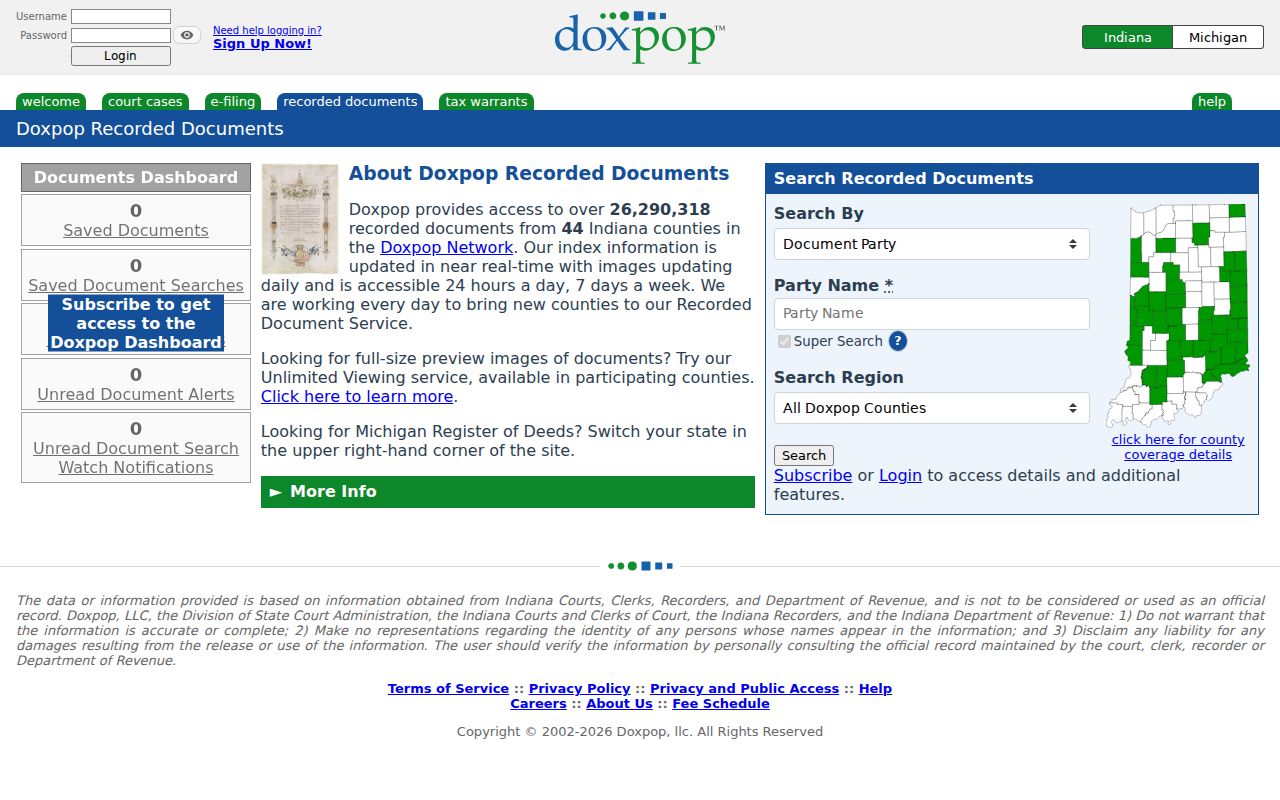
Start from an exact name on the newest deed. The legal description anchors the land. For every hit, record the document type, recording date, instrument or book/page reference, parties, and legal description. Images and detailed data may cost a fee. If an image is unavailable, carry the exact index reference to the Recorder instead of guessing from a result title.
Use Dearborn Maps and Directories as Name Clues
Old atlases, plats, Sanborn maps, city directories, newspapers, and obituaries can explain a vanished address. They can also explain a puzzling name change. Lawrenceburg Public Library District holdings include Route 48 realignment research. Aurora adds its own wrinkles. River, ferry, and rail history there gives old addresses contexts. Those contexts no longer fit the modern map.
These sources place people and structures in time. They do not convey title. Carry every clue back to a deed book, probate record, or recorded plat. Match the legal land description before trusting it.
Continue Former-Owner Research at the Dearborn Counter
When online browsing stops, call the Recorder. Describe the book, page, parties, and dates found. The Indiana State Library and State Archives add microfilm, atlases, probate material, and staff-assisted research. Search their holdings by county.
Use the county APRA form for a specific existing record that is not otherwise available. Inspect first when the volume is uncertain. Request certification only when the purpose requires it, and confirm any charges before ordering.
Account for Dearborn's 1826 Courthouse Fire
In 1826, fire destroyed most early Dearborn County property records. A few marriages and wills survived. When a chain of title stops before the available deed books, the cause may be genuine record loss. It may not be a missing conveyance. Never fill that gap with an unsupported owner.
Surviving wills, probate books, patents, and plats can frame a careful hypothesis instead. So can tax material and newspapers. Say plainly which link rests on inference and which a recorded deed proves. The fire demands source discipline. It grants no license to merge people who share a surname.
Directory and obituary names are clues only. A resident, heir, or business operator may never have held title. Log each source, date, spelling, and parcel identity. Label every unresolved gap too. That habit keeps one same-name hit from masquerading as a valid link in the Dearborn County deed chain.
Test a changed road context. Never assume it. Compare the old directory entry with a Sanborn sheet or plat, then locate the tract by subdivision, lot, section, township, range, or a neighboring owner of record. The county has no official countywide street-renumbering project. Even so, route realignment, postal naming, and local address habits can make a historic address fail in the current property search.
The Recorder publishes no stable fee schedule, so call before sending payment. Say whether the need is inspection, an ordinary copy, or a certified copy. For mail or email, cite the precise record. Do not ask staff to rebuild the chain. When retrieval or review takes longer, a response may arrive before final production.