
Identify Who Owns Dearborn County Property
Address to parcel to tax-roll owner to recorded deed is the strongest route. No single lookup answers everything. Dearborn County's tax list gives the fastest owner lead, Beacon and the GIS map help match the land, and the Recorder's Doxpop deed index backs the answer with transfer evidence.
- Start with the address. Search the county tax list by Property Address, or use Beacon when a map is needed.
- Capture the owner string. Save the exact person, LLC, trust, or estate name plus the full PIN and alternate ID.
- Match the land. Compare situs, tax district, subdivision, and geometry so a same-name result does not mislead.
- Confirm the transfer. Search the owner and prior party in Doxpop, then compare the latest grantee, date, and legal description.
Going the full route beats stopping at the first name. For the deeper dive, the Dearborn County current owner page holds the detailed record. Here the focus stays on the route itself.
Read Dearborn County's Tax-Roll Owner Field
The county property search accepts District number, Parcel number, Name, Tax Year, and Property Address. A result can display the district, the full Indiana PIN, an alternate parcel, Owner, situs, and year. That Owner field is the central lead for who owns the property on the roll.
| Displayed item | How it supports the owner check |
|---|---|
| Owner | Exact person or entity string on the tax roll |
| Property Address | Situs used to match the physical site |
| PIN / alternate parcel | Cross-system key for GIS, tax, and deed work |
| District | Tax geography at municipal edges |
| Tax year | Roll period represented by the result |
The page carries a “Not for Official Use” label. It showed a September 7, 2026 update. Even so, a deed recorded moments earlier may not have reached the roll yet.
Compare Dearborn County Property Owner Sources
Each Dearborn source performs a different public task. Used in sequence, they answer both which owner name is displayed and what recorded transfer supports it.
| Where ownership appears | What it gives | How current |
|---|---|---|
| County tax list | Owner string, situs, PIN, district | Current roll context; may lag a sale |
| Doxpop deed index | Grantor, grantee, recording date, instrument | Newest recorded conveyance is stronger confirmation |
| Beacon / county GIS | Parcel location, subdivision and record references | Reference geometry, not title proof |
Doxpop's basic party-name index is free. Images and extra details may cost a fee. Address and APN are not guaranteed index fields there, so start with the tax roll to confirm the exact owner of record and the parcel number before you dig deeper.
When a portal stalls, the county still has options. Call the Assessor at (812) 537-8809 or the Recorder at (812) 537-8837, stop at the counter in person, or file the county APRA form to request an existing record.
Trace a Dearborn LLC or Trust to the Parcel
An LLC in the Owner field names the assessed entity, not an individual resident. Copy the full legal spelling and run it through the Indiana INBiz business search. It supports Business Name, Business ID, Filing Number, Registered Agent Name, and Incorporator or Governing Person Name. Search options include Contains, Starts With, and Exact Match.
The entity result resolves punctuation, former names, and registered-agent details. It does not prove parcel ownership. Return to the newest deed and match the entity, legal description, and date. A trust may be indexed under a trustee or family name. An estate may call for the personal representative, a probate order, or an executor's deed.
Note: A registered agent, trustee, or personal representative serves a legal role. It is not necessarily the beneficial owner or occupant.
When a New Dearborn Deed Beats the Roll
No official Dearborn County source promises a closing-to-roll update time. A fresh transfer can leave the former owner displayed for a while. Whenever timing matters, check the most recent Doxpop recording date and grantee.
For a parcel split or combined in the past two years, county guidance suggests trying the owner's last name if the parcel number fails. Compare old and new PINs, map location, and legal descriptions. The land persists while its database key changes.
Use Dearborn Property Watch as an Alert
Doxpop Property Watch can alert a user when a chosen name appears on a newly recorded document. It matches names, not addresses or APNs. So common names and rural descriptions may trigger irrelevant alerts. It cannot prevent recording or judge whether an instrument is valid. The alert service works alongside Dearborn County records as a monitoring prompt.
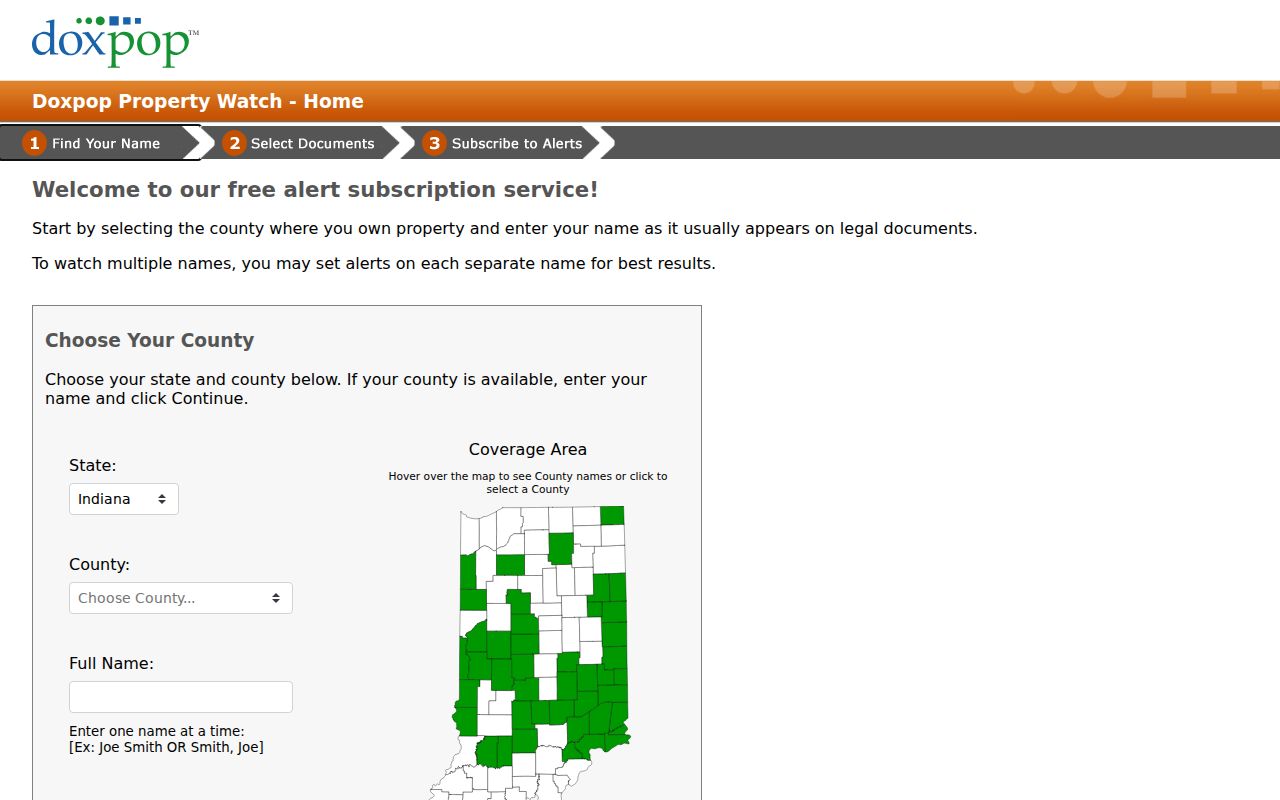
Treat an alert as a prompt to inspect the instrument and contact the Recorder. It is not an ownership conclusion.
Separate Dearborn Situs From Mailing Address
The situs is where the property physically sits. The mailing address is where tax correspondence goes. It can lie outside the county or state. A postal city or ZIP may cross a municipal line. Neither address says who occupies the premises. Neither changes the grantee named in a deed.
- Owner of record
- The party shown on a particular official roll or instrument.
- Grantee
- The party receiving the interest stated in a deed.
- Title
- The legal ownership interest, not established by a web name alone.
- Situs
- The physical property address, distinct from correspondence address.
These distinctions keep an owner search from drifting into an occupant search. Public property records describe assessed and recorded interests, not who is physically present.
Follow the Dearborn Estate-Transfer Handoff
A death-related transfer rarely forms a clean deed-to-deed line. The tax owner may show an estate or a former owner while probate stays open. Search MyCase and the Clerk for the probate case. Identify the representative and their authority. Then look for the personal representative's deed, survivorship evidence, an affidavit, or a court order. The deed remains the land record. The probate file explains authority. Death evidence can establish identity or relationship but is not itself a conveyance. This human handoff is one reason the three-record check matters.
Know the Limits of Dearborn Ownership Results
The roll can identify its owner string. The deed index can identify a recorded conveyance. Neither web display is a title opinion. A deed may cover only part of a tract or a limited interest. Probate orders, liens, easements, or unreleased instruments may still shape the full picture. An indexing error may do the same.
An owner name is not proof of title. The roll may lag, and ownership may sit in an LLC, trust, or estate. Confirm the newest deed and use professional title work when reliance matters.
Dearborn County property records serve lawful ends. They support purchase research, estate work, fraud monitoring, and boundary checks, never stalking or harassment. Ask the Recorder for an official copy when an index summary is not enough.
Confirm Who Owns the Dearborn Parcel in Doxpop
The Doxpop Recorder search starts with Party Name, Super Search, and Search Region. Advanced access adds Legal Description and Document Information. Search the tax roll owner, then the prior party. Match the land rather than the name. Address and APN are not required index fields. Compare the legal description, subdivision, section, recording date, and related instruments instead.
Doxpop indexes every document type from July 2000 and deeds from 1988. Its historical deed browse reaches 1903, but browsing is not an indexed search for every old instrument. Paid access may apply to images and details. If an image is unavailable, take the exact reference to the Recorder or request the existing record through APRA.
Move From a Dearborn Owner Lead to an Official Record
Online access is only one channel. The Recorder offers public inspection and copies in person. The county APRA form lets a requester describe an existing record, choose inspection or a copy, and pick fax, email, mail, or hand delivery. Ask for a named deed or parcel card. Never ask the office for a title analysis.
The county quotes 24 business hours for hand-delivered requests. Fax, email, and mail requests carry a seven-calendar-day window. A response is not always final production, since review or retrieval can take longer. The county publishes no stable current fee schedule, so call the Recorder at (812) 537-8837 before sending payment.
Note: When the tax owner and the newest deed disagree, keep both dates and ask the Assessor or Recorder which update applies.
A date mismatch is common. Tax rolls and deeds update on different schedules. Call either office with the PIN, party names, and instrument reference, and ask which update controls. One clear question resolves the mismatch.